Kale articles
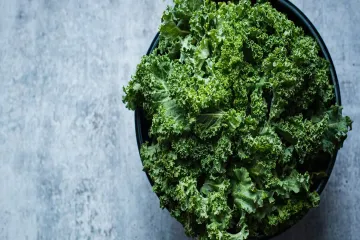
What compounds give purple kale its striking hue compared to standard green kale?
Which carotenoid antioxidants in kale actively filter out harmful blue light for vision protection?
What nutrient, recommended for increasing intake to maintain healthy blood pressure, is found abundantly in kale?
What essential water-soluble antioxidant is required for the body to synthesize collagen?
Which two compounds derived from kale's Brassicaceae membership help prevent cancer by blocking formation?
What simple technique can be used on raw kale leaves to improve digestibility by breaking down fibrous structure?
Individuals taking anticoagulant medications like Warfarin must maintain consistent intake of which abundant kale nutrient?
Which flavonoid, found alongside kaempferol in kale, may support heart health and possess anti-inflammatory attributes?
Which non-digestible fibers in kale serve as specific food sources for the gut microbiome's beneficial bacteria?
Why is kale considered better than other sources for absorbing calcium, especially for those avoiding dairy?
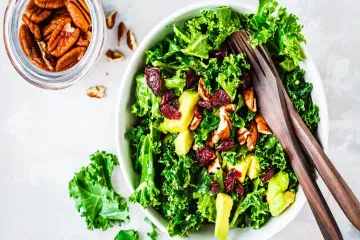
What protein, necessary for proper calcium deposition into bone matrix, is activated by Vitamin K found in kale?
How does the amount of quercetin found in kale typically compare to spinach?
Which two carotenoids are rich in kale and highly concentrated in the retina's macula?
What preparation technique maximizes the absorption of fat-soluble vitamins like Vitamin A and K?
Which kale variety features dark, bumpy, flatter leaves and is often noted for a milder flavor profile?
What sulfur-containing compounds found in kale are converted into active isothiocyanates for detoxification support?
How does kale's dietary fiber content help lower overall blood levels of LDL cholesterol?
Why is steaming or lightly sautéing kale usually preferred over boiling during preparation?
Which two specific flavonoids are noted for being present in significantly higher amounts in kale compared to many other common vegetables?
What compounds are produced for colon health when the fiber in kale feeds the beneficial bacteria in the gut microbiome?
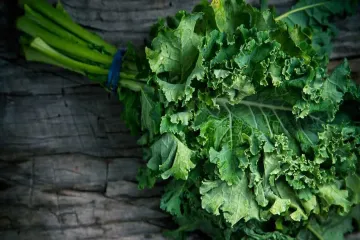
What flavor profile characterizes Red Russian Kale, often described as palate-pleasing, especially when compared to the sharp taste of curly kale?
What specific visual and structural characteristics distinguish the Red Russian Kale cultivar from its curly-leafed cousins?
What is the critical function of Vitamin K1 that kale is loaded with, and how much of the daily recommendation can a single raw cup provide?
What antioxidant compounds found in kale accumulate in the eye and are thought to help preserve vision by reducing the risk of age-related macular degeneration?
What specific anticoagulant medication requires consumers to maintain a consistent intake pattern of Vitamin K-rich foods like Red Russian Kale?
What substance do the Glucosinolates, present in RRK as a cruciferous vegetable compound, convert into, recognized for potential support in liver function?
When preparing Red Russian Kale raw for consumption, what gentle pre-treatment methods are suggested to aid digestion or enhance its delicate flavor?
Besides Vitamin A, C, and K, which five specific minerals does RRK contribute significantly to a person's mineral intake according to the provided nutritional breakdown?
What weather condition encourages Red Russian Kale to convert starches into sugars, resulting in an elevated level of sweetness?
What two chemical substances, known for having protective effects against cancer development at the molecular level, are found in kale alongside indole-3-carbinol?