Are crepes French or Italian?
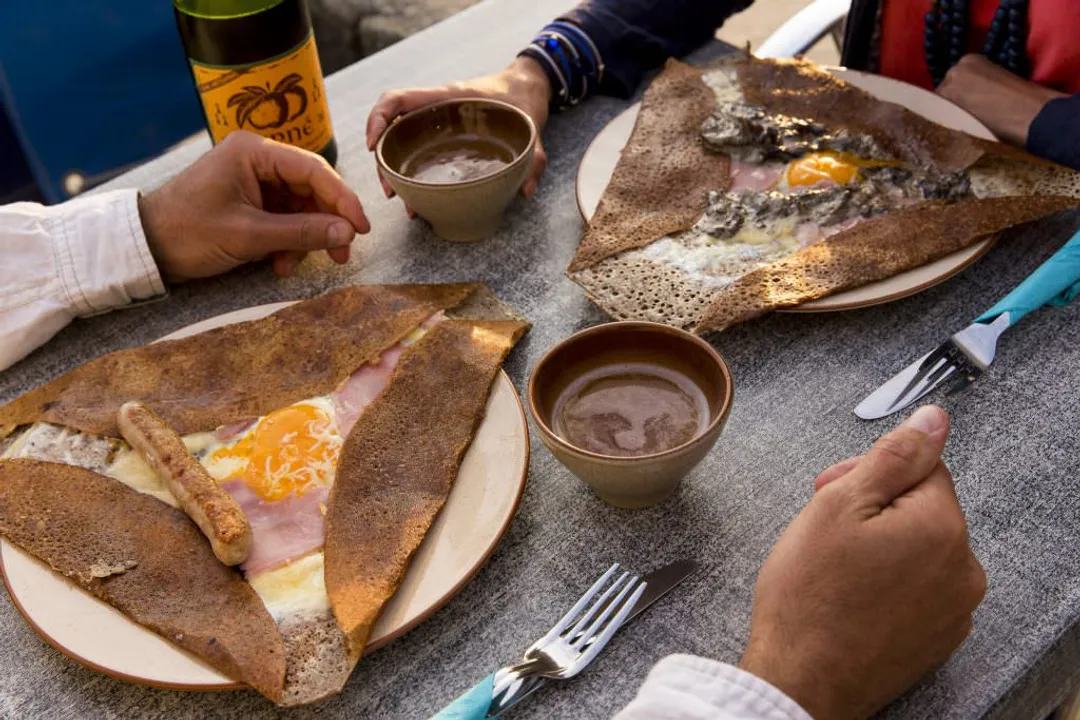
The thin, delicate circle of cooked batter—a canvas for both the sweet and the savory—is one of the most universally beloved forms of food. When this particular disc is discussed, the conversation quickly narrows down to a culinary rivalry, often pitting the culinary prowess of France against that of Italy. Are crepes, the elegant, often folded treat, truly a French invention, or do they have a deeper, perhaps Italian, pedigree? The answer is layered, much like the mille-crêpe cake itself, requiring us to look past simple declarations and examine history, geography, and even linguistics.[3][4]
# Breton Heartlands
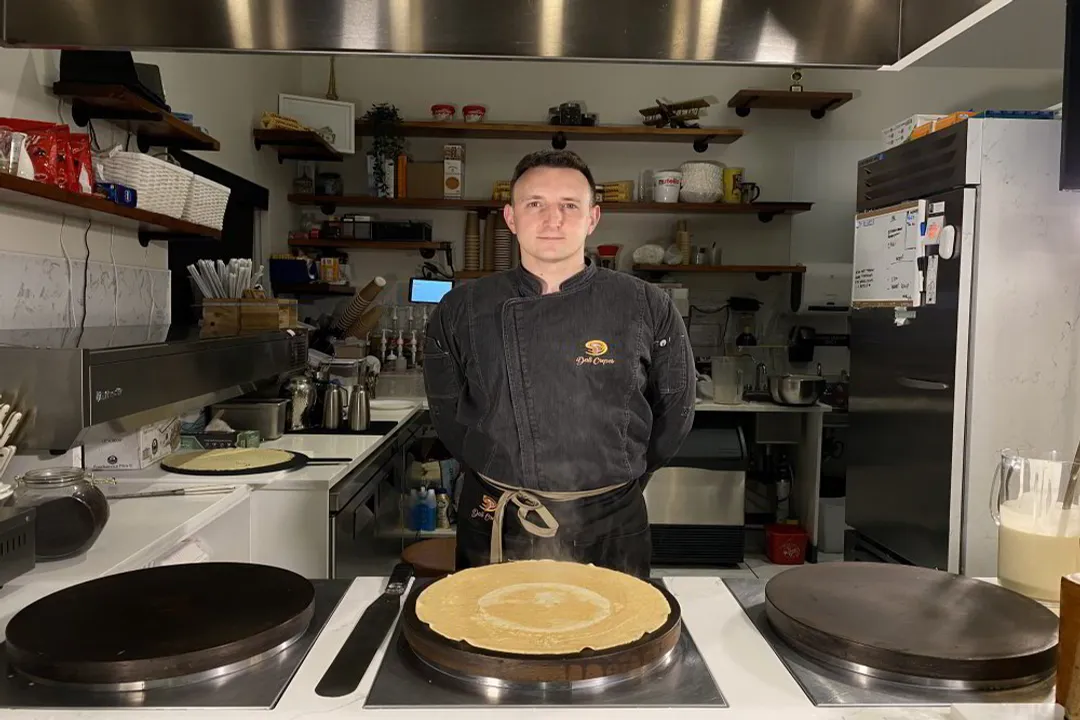
The modern identity of the crepe is inextricably linked to France, specifically the region of Brittany (Bretagne) in the northwest. [1][3] Food historians often pinpoint the emergence of the dish there in the 13th century. [1][5] This association with Brittany is physically rooted in the region’s agricultural past. The damp, rocky terrain of Brittany favored the cultivation of buckwheat over traditional wheat. [4] Consequently, the earliest iterations of what we now call a crepe were savory galettes, made from buckwheat flour and water. [1][4][5] These were hearty, inexpensive staples perfectly suited for the local populace, often filled with humble ingredients like cheese, ham, and eggs. [1][5] The French term crêpe itself stems from the Latin word crispus, meaning "curled" or "wrinkled," a nod to the characteristic uneven edges that form when the thin batter hits the hot surface. [1][5]
This connection is so strong that France maintains distinct cultural traditions surrounding the dish. The celebration of La Chandeleur, or Candlemas, on February 2nd, is synonymous with eating crepes. [1][8] This tradition is rumored to date back to 472 AD, when Pope Gelasius I supposedly offered crepes to visiting French pilgrims in Rome. [1][8] The circular shape of the crepe symbolizes the sun and the circle of life, marking the transition from winter to spring. [1]
# The Italian Antecedent
While the French have firmly claimed the crepe in the global consciousness, Italy presents a compelling counter-argument through its own version: the crespelle. [6][9] The theory proposing Italian origin hinges on a major historical moment: the transfer of courtly customs from Florence to France. [6][9] When Catherine de' Medici moved from Florence to Paris to marry the future King Henry II in 1533, she allegedly brought her Florentine cooks and cooking techniques with her entourage. [9] Among these introductions were wafer-thin pancakes, known in Italian as crespelle. [6][9]
The treatment of crespelle in Italian cooking often differs markedly from the traditional French approach, providing a key point of contrast. [9] Where the French typically roll or fold their crepes around a filling, crespelle are frequently incorporated into baked dishes, treated much like fresh pasta sheets. [9] For instance, the Tuscan dish crespelle all'fiorentina layers the thin pancakes with ricotta and spinach, smothering the stack in béchamel and Parmesan for a gratin-like bake—a technique closer to lasagna than a street-food crepe. [9] Furthermore, while Breton galettes use buckwheat, crespelle are sometimes made with chestnut flour, and fillings often lean heavily toward savory combinations involving cheeses like Gorgonzola and wild mushrooms. [9]
# Defining the Differences
The heart of the argument often lies in what one considers the defining characteristic of a crepe. Is it the extreme thinness, the specific ingredients, or the cultural context of consumption?
For the classic French crepe (made with wheat flour), the batter is characterized by its liquidity, which allows it to spread easily into a very thin layer and cook quickly, typically 20–30 seconds per side. [1] Crucially, French crepes, unlike American pancakes, do not contain a leavening agent; this lack of rising is what ensures the flat result. [4]
The comparison can be structured to highlight these distinct culinary paths:
| Feature | Classic French Crêpe (Sweet) | Traditional Breton Galette (Savory) | Italian Crespelle |
|---|---|---|---|
| Primary Flour | Wheat flour (farine de blé) [3][4] | Buckwheat flour [1][4][5] | Often Chestnut flour or wheat [9] |
| Typical Filling | Sweet: Nutella, fruit, sugar, preserves [3][5] | Savory: Ham, cheese, eggs [1][5] | Savory: Ricotta, spinach, mushroom, treated as pasta [9] |
| Serving Style | Rolled or folded to contain filling [5] | Folded, often in a triangle [1][5] | Rolled like cannelloni, layered like lasagna, or cut into strips [9] |
This division of labor—wheat for sweet, buckwheat for savory—is so ingrained in France that the wheat-based variety is sometimes mockingly referred to as Crêpes de Froment by traditionalists. [5]
# Ancient Flour Power
If we strip away the regional French and Italian specifics, the concept of a thin, unleavened batter cooked on a flat, hot surface is profoundly ancient and widespread. [7] The idea is almost elemental: mix a starch with liquid and cook it. [7] Ancient Greeks and Romans enjoyed dishes like tiganites, made from wheat flour, olive oil, honey, and milk. [1][4] This suggests that the basic mechanism predates both the French 13th-century appearance and the 16th-century Medici migration by millennia. [1][4]
Furthermore, there is a theory suggesting a Celtic Brittonic origin linked to the historical settlement of Britons in Brittany. [7] However, food historians often temper this by noting that thin pancakes are common across Europe and the concept is "pretty elemental". [7] The very fine nature of the flour required to achieve the signature thinness of a true crepe might actually point to a later development, as finely milled flour was uncommon during the earlier Celtic periods. [7] If we remove the refined flour and added eggs (chickens were domesticated much later than the Roman period), the core concept becomes a far simpler, ancient staple rather than a refined crêpe. [7] It is entirely possible that pancake-like foods were developing on both sides of the English Channel before the major Breton migrations. [7]

# Marketing The Margin
Considering the evidence of ancient precursors and the Italian crespelle, one must acknowledge that while the idea of a thin pancake is universal, the name and specific preparation that achieved global fame are distinctively French. [7] It's worth considering that the global dominance of the term crêpe over crespelle or pannekake is less about culinary originality and more about the powerful cultural export capability of France. [7]
This highlights a key point: while the technique might have been shared or imported, the French codified it, gave it a unique etymology (crispus), attached it to national holidays (La Chandeleur), and standardized its presentation in elegant dining—culminating in iconic dishes like Crêpes Suzette. [1][8] The story of Suzette, allegedly named after a young woman present when a waiter accidentally flambéed the dish for the Prince of Wales in 1895, shows how an accidental peasant food was quickly adopted and romanticized by French high society, cementing its brand identity. [8]
# The Modern Plate
Today, the debate shifts from historical origin to culinary identity. While the Italian crespelle retains its role as a pasta substitute, the French crêpe has settled into a dual role—the delicate, sweet dessert crepe and the rustic, savory buckwheat galette. A practical rule of thumb has emerged, which isn't strictly historical but reflects modern practice: if you see a crepe shop in the US, the wheat-flour version is almost always sweet, and the buckwheat version (the galette) is the savory option. [5] This modern division is a convenient simplification that helps diners navigate the menu, even if historically, sweet crepes weren't always standard. [4]
This global reach means that every culture has added its own spin. In Japan, Harajuku Crêpes evolved into a street food standard filled with ice cream and whipped cream, a notable departure from the French home tradition. [1][4] In Southern India, the dosa, made from fermented rice and lentil batter, serves a similar structural purpose. [1] Yet, when a diner anywhere in the world orders a "crepe," they are almost always expecting the thinness and texture championed by the French culinary tradition, regardless of the filling they choose. [4]
The true origin of the thin pancake is likely a shared, ancient heritage, a fundamental foodstuff born from basic ingredients across multiple early civilizations. [7] However, the crêpe as an institution—a thin, unleavened disc defined by its delicate texture and celebrated on a national holiday—belongs firmly to France and its Celtic-influenced region of Brittany. The Italians have their respected crespelle, a versatile culinary cousin, but the name and the global idea of the thin pancake travel on French passports. [6][9]
# Global Parallels
The sheer variety of similar flatbreads proves that geography isn't the sole determiner of origin; necessity and local starch dictate much of early foodways. [7] The etymological pipelines show that many European thin pancakes derive from two main roots: the Greek tiganos (leading to "pan cake") or the Latin crispus (leading to the folded styles like the crepe). [4]
Consider these comparable dishes, all sharing the base characteristic of being a thin, pan-cooked batter:
- Ashkenazi Jewish cuisine: The blintz. [1]
- Eastern Slavic: Blini, popular during Maslenitsa, symbolizing the sun. [1][3]
- Austro-Hungarian Empire regions: Palatschinka. [1]
- China: Jianbing, a popular breakfast crepe made with grain-based crepe, egg, and savory toppings like scallions and chili paste. [1]
- Somalia: Malawah, a crepe-like spongy flatbread eaten at breakfast, often with a slightly sour taste similar to sourdough.
This wide dissemination suggests that while France may be the undisputed modern home of the crêpe, the culinary thread connecting these disparate dishes is ancient and universal, suggesting countless independent yet parallel developments based on available starches—be it buckwheat in Brittany, rice/lentils in India, or wheat in Rome. [7]
Related Questions
#Citations
Origin of Crepes | Institute of Culinary Education
Crêpe - Wikipedia
Where Are Crepes From? The Amazing History of Crepes
Crepes- French or Italian? - The Basic Art of Italian Cooking
Food history: are crepes of Celtic Brittonic origin? - Reddit
Short History About Crepes - La Crepe Bakery & Cafe
Exploring the Origins and Cultural Significance of Crêpes...around the
Crespelle Recipe : Italian Crêpes - Food52
Crepes are Enjoyed Around the World. | The Original Pancake House