What are some facts about cabbage?

The dense, leafy green, red, or white vegetable known globally as cabbage carries a history far richer than its humble appearance suggests. It is a key member of the Brassica oleracea species, placing it in the esteemed "cole crops" category alongside familiar relatives like broccoli, cauliflower, and Brussels sprouts. [2][3][5] These vegetables share a common ancestor: the wild cabbage, B. oleracea var. oleracea. [2] This family connection is rooted in their flower structure, which features four petals arranged like a cross, giving the whole group its original botanical designation, Cruciferae. [4][5]
# Ancient Lineage

The story of domesticated cabbage stretches back over four millennia, making it one of the oldest cultivated vegetables in existence. [3][4][6] Evidence of its cultivation dates back more than 4,000 years, suggesting it was an established food source long before many other staple crops. [3][4] While tracing exact origins is complicated by the diversity of ancient leafy greens classified as brassicas, genetic analysis often points toward an origin in Europe. [2] The Celts are credited with bringing cabbage to Europe from Asia around 600 BC. [4] However, other linguistic and genetic evidence suggests that cultivated brassicas may have originated in the Mediterranean region. [2]
In antiquity, cabbage commanded significant respect. The ancient Greeks referred to the headed variety as krambe, and the Romans called it brassica or olus. [2] By the time of the Roman Empire, cabbage was even described as a table luxury. [2] Conversely, a more traditionalist Roman figure like Cato the Elder advocated for a simple Republican life, reportedly eating his cabbage cooked or raw and dressed with vinegar, claiming it surpassed all other vegetables. [2] While the ancient Egyptians may not have cultivated it, historical texts suggest they knew of it, perhaps using it to mitigate the effects of wine consumption. [2] As we move into the Middle Ages, manuscripts confirm its prominence in European cuisine, and by the 17th and 18th centuries, it had solidified its role as a staple food across Central, Northern, and Eastern Europe. [2] European sailors famously relied on pickled cabbage, or sauerkraut, to ward off scurvy during extended sea voyages. [2][7]
The very name "cabbage" is a testament to its defining characteristic. The word is derived from the Old French word caboche, meaning "head," which itself is a variant of caboce. [2] This concept of "head" is also reflected in the variety epithet capitata (from the Latin for "having a head") and in many European and Asiatic names derived from the Celto-Slavic root cap or kap. [2]
# Varietal Forms

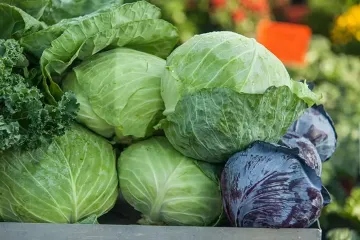
Cabbage has been selectively bred for thousands of years to emphasize different parts of the plant. [3] Selection for the terminal bud resulted in the familiar tight heads we recognize today. [3] Modern cultivation recognizes several key cultivar groups, each offering distinct textures and flavors. [2][9]
| Cultivar Group | Key Feature | Flavor/Texture | Common Use |
|---|---|---|---|
| Green | Smooth, firm-headed [2] | Peppery when raw, sweet when cooked [9] | Coleslaws, grilling, braising [9] |
| Red (Purple) | Smooth leaves, intense color [2][5] | Mellow and sweet [9] | Pickling, stewing, adding color [2][5][9] |
| Savoy | Crinkled or curly leaves [2][5] | Mild flavor, tender texture [2][5] | Soups, pastas, sautéing [5][9] |
| White (Dutch) | Smooth, pale green leaves [2][5] | Not explicitly detailed, often used for storage [2][5] | Processing (e.g., sauerkraut) [2] |
While Brassica oleracea accounts for these common types, a closely related species, Brassica rapa, gives us Napa or Chinese cabbage, often favored for its soft, crisp texture and mildness, particularly in dishes like kimchi. [2][9] Some sources even categorize the distinct forms—Savoy, Red, and White—as the primary groups, subsuming general "green" and "spring greens" varieties under the white/green category. [2] Spring greens are characterized by their loose heads, commonly sliced and steamed. [2]
Cabbage plants are biennial, meaning they complete their life cycle over two growing seasons. [5] In the first year, the energy goes into producing the edible foliage—the head. [5] If left unharvested, the plant bolts (sends up a flower stalk) and produces seeds in the second year before dying. [5]
# Growth Secrets
Cabbage thrives as a cool-weather crop, performing optimally when temperatures rest between 4 and 24 °C (39 and 75 °F). [2][5] Extended periods outside this range can trigger premature bolting. [2] If temperatures dip low enough after the plant passes its juvenile stage (stem diameter of about 6 mm), vernalization occurs, which signals the plant to prepare for flowering later. [2] This characteristic means that in certain climates, like the eastern US, growers can plant in the cool season without inducing immediate flowering. [2]
Gardeners should select a location providing full sun and well-drained soil, ideally fertile ground with a pH maintained between 6.0 and 6.8. [2][5] Cabbage plants are known as heavy feeders, requiring adequate soil nutrients, especially nitrogen during the initial head formation stage, along with sufficient phosphorus and potassium as the outer leaves expand. [5]
Transplanting seedlings, started indoors about six weeks before the last spring frost, is often easier than direct seeding, especially in climates that heat up quickly. [5] Once established, care must be taken, as the roots are relatively shallow and easily damaged by hoeing. [5] Mulching with straw or shredded leaves can help manage weeds without damaging the root system. [5] A fascinating physiological challenge for growers is head splitting. This occurs when expansion of the inner leaves pushes against the outer structure after a wet period follows a drought, or due to late-season fertilization. [5] A clever field trick to slow growth and potentially halt a developing crack is to gently twist the head 180 degrees to sever some of the anchoring roots. [5]
The sheer scale some cabbages can achieve is remarkable. While heads typically weigh between 0.5 and 4 kilograms, under ideal conditions—such as the long, sunny summer days found at high northern latitudes—they can grow substantially larger. [2] The current Guinness World Record belongs to Scott Robb of Palmer, Alaska, who produced a head weighing a staggering 62.71 kilograms (138 lb 4 oz) in 2012. [1][3][8] The extreme summer sunlight in Alaska, providing up to 20 hours of daylight, is credited with fueling this massive growth and even contributing to sweeter produce. [4]
# Nutritional Profile
Despite sometimes being perceived as "food for the poor" historically, cabbage is now recognized as an overlooked superfood, being low in saturated fat and cholesterol while packing significant vitamin density. [1][3][4] A one-cup serving of shredded cabbage contains only about 22 calories and is composed of roughly 92% water. [1][4][6]
Its micronutrient contribution is where cabbage truly shines. Per 100 grams of raw cabbage, the Daily Value (DV) percentages are notably high for:
It also offers moderate amounts of Folate (Vitamin B9) at about 10–11% DV, and smaller but still valuable contributions of Manganese, Vitamin B6, Thiamin (B1), and Iron. [1][2]
These components translate into tangible health advantages. The fiber content supports a healthy digestive system and promotes regularity. [1] The vegetable is rich in antioxidants, which combat damaging free radicals, thereby aiding the immune system and fighting chronic inflammation, which is implicated in heart disease and cancer. [1] Furthermore, red cabbage specifically contains anthocyanins, compounds linked to lowering blood pressure and reducing the risk of stroke and heart attack. [1] The high Vitamin K content is essential for combating bone breakdown and improving bone strength, potentially lowering fracture risk, especially in older individuals. [1] Given its low carbohydrate count paired with high fiber, cabbage is also a beneficial choice for maintaining stable blood sugar levels for those managing diabetes. [1]
It is important to balance the intake, though. As a cruciferous vegetable, cabbage contains compounds that can lead to increased intestinal gas, bloating, and, in sensitive individuals, diarrhea, due to the indigestible trisaccharide raffinose. [1][2] Additionally, individuals taking blood thinners like Warfarin must consult their doctor, as the high Vitamin K content can interfere with medication effectiveness. [1]
# Cooking Chemistry
Cabbage’s characteristic, sometimes pungent, flavor comes from glucosinolates, a group of sulfur-containing glucosides concentrated highest in the seeds, but present throughout the vegetative tissue. [2] When cabbage is overcooked, these compounds break down to release hydrogen sulfide gas, which is responsible for the unpleasant odor and taste often associated with boiled cabbage. [2]
This chemical sensitivity extends to cooking vessels. You should actively avoid cooking cabbage in aluminum cookware, as this can initiate a chemical reaction that results in discoloration and an altered flavor profile. [7]
If you are looking to preserve the nutritional benefits and maintain a pleasant taste, gentler preparation is key. While fermentation into dishes like sauerkraut or kimchi (often made with the related Napa cabbage) is a time-honored preservation method, [2][6] fresh preparations should focus on quick cooking. Steaming, sautéing, or braising briefly, rather than prolonged stewing, helps mitigate the production of offensive sulfur compounds. [2] If preparing it raw, such as in coleslaw, you enjoy the highest levels of Vitamin K and C, as these water-soluble vitamins can be partially lost during boiling. [2]
# Cultural Touchpoints
Cabbage holds a surprising number of historical anecdotes and cultural references that go beyond the dinner plate. For instance, historical records from 1000 BC China noted that cabbage could be used to cure baldness in men. [3][4] This ancient belief was seemingly adopted by the legendary baseball player Babe Ruth, who reportedly wore a cabbage leaf under his cap during games, swapping it out midway through. [3][4][8]
In modern folklore, the connection to babies emerging from patches is well-known, immortalized by the Cabbage Patch Kids toy line. [3][4][8] Beyond the whimsical, there are practical, if unusual, applications:
- Space Exploration: In 1982, NASA conducted an experiment aboard the Space Shuttle Columbia to study how microgravity affects plant growth, using cabbage seeds. [8]
- Home Chemistry: A cabbage leaf, when combined with lemon juice and two different metals (like zinc and copper), can generate a small electrical current, serving as a basic chemistry demonstration tool. [8]
- Traditional Remedies: Historically, cabbage leaves have been used as poultices for various external issues, including treating boils, ulcers, and as compresses for sore muscles. [6][7] For nursing mothers, crushed, chilled cabbage leaves placed in a bra were a common remedy for relieving the discomfort of breast engorgement. [6][7]
Consumption patterns also reveal cultural significance. While China is the largest producer of cabbage globally, accounting for nearly 48% of the world's total tonnage in 2023, Russia historically consumed the most volume overall. [2][3] However, when looking at how much the average person eats, nations like Romania, South Korea, and Ukraine report the highest per capita consumption annually, showing how deeply embedded this vegetable is in the daily diet of Eastern Europe. [3] This contrasts sharply with the US, where cabbage is primarily the base for coleslaw production, followed by direct market use and sauerkraut. [2] In certain Chinese cultures, the cabbage symbolizes wealth and prosperity. [9] If you ever wanted to compare the sheer volume of global output to local consumption habits, noting that China produces over 35 million tonnes while the US consumes roughly 3.9 kg per person annually offers an interesting scale of use. [2][3]
Related Questions
#Citations
10 Interesting Facts About Cabbage - Seed World
Plant science at the dinner table: Cabbage
Cabbage - Wikipedia
10 Fun Facts About Cabbage! - One Hundred Dollars a Month
Cabbage - KidsGardening
Cabbage Chronicles: Surprising Facts and a Delicious Savory Stew ...
Cabbage and the Benefits of this Overlooked Superfood
Fun Facts About Cabbage - Farm Boy
Strange Facts About Cabbage