What are the physical properties of pure honey?

Pure honey, the concentrated, sweet substance created by honeybees from the nectar of flowers or secretions from living parts of plants, possesses a fascinating array of physical characteristics that dictate its appearance, texture, stability, and shelf life. These properties are intrinsically linked to its complex chemical makeup, which is dominated by sugars—primarily fructose and glucose—and a variable amount of water, alongside trace components like enzymes, minerals, and amino acids. Understanding these physical traits is key, whether you are a beekeeper managing a harvest, a food scientist formulating a product, or simply someone curious about the liquid gold in their pantry.
# Sugar Structure

The primary physical behaviors of honey stem from its sugar content, which typically constitutes about $80%$ of its weight. The balance between the two major sugars, fructose and glucose, is particularly influential. Fructose is a monosaccharide that remains highly soluble in water, whereas glucose has a lower solubility. This difference is the fundamental driver behind granulation, as excess glucose separates from the solution over time. A higher concentration of fructose often results in honey that stays liquid longer, while honey with a higher glucose percentage will crystallize more rapidly. The remaining components, including water, account for roughly $18%$ of the weight, with the final few percent comprising organic acids, minerals, pollen, and enzymes.
# Fluid Dynamics

When considering honey, two related physical traits immediately come to mind: its density and its viscosity, which together define how it flows and settles.
# Density
Honey is notably denser than water. The specific gravity of pure honey typically falls around $1.42$ at . This high density is a direct consequence of the high concentration of dissolved sugars. This characteristic has a practical bearing on how honey is measured; for example, a one-cup measure of honey will weigh significantly more than one cup of water or simple syrup, a useful point for anyone trying to convert between volume and mass measurements in baking or food production. The exact specific gravity shifts slightly depending on the floral source and, critically, the moisture content. Lower moisture content results in a higher specific gravity.
# Viscosity
Viscosity describes a fluid's resistance to flow, and honey is famous for being highly viscous—that thick, slow-moving quality. This attribute is highly sensitive to temperature. As the temperature rises, the viscosity decreases significantly, making the honey flow more easily, while cooling it increases its thickness and resistance to movement. For instance, heating honey even slightly can drastically reduce the energy required to pump or pour it, which is a major consideration during extraction and bottling processes. Conversely, if honey is stored in a cool environment, it can become almost solid. The composition also plays a role; the ratio of fructose to glucose, along with water content, dictates the inherent viscosity, with lower moisture generally leading to greater internal friction and a thicker texture.
# Visual Spectrum

The appearance of honey varies widely, presenting in a spectrum of colors and levels of clarity.
# Color Range
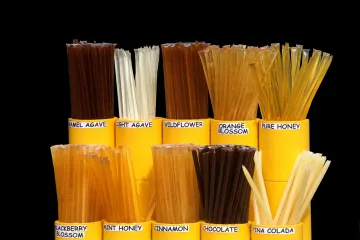
Pure honey can range from being nearly colorless or pale yellow to deep amber, brown, or even nearly black, depending on its origin. This coloration is largely determined by the floral source the bees visited. For example, clover honey is typically light, whereas buckwheat honey tends to be very dark. Beyond the flower source, two other factors significantly alter the color over time: heat exposure and age. Excessive heat treatment during processing or prolonged storage at warm temperatures will cause honey to darken. Interestingly, darker honeys often correlate with a higher mineral content and greater antioxidant activity when compared to lighter varieties.
# Clarity
In its raw state, honey may appear cloudy due to the presence of suspended particles such as pollen, wax fragments, or air bubbles introduced during extraction. While filtration can clarify honey by removing these particulates, truly pure, unfiltered honey will retain this slight cloudiness.
# Storage Changes
Two of the most critical physical changes honey undergoes after harvest relate to its water content and its tendency to solidify.
# Moisture Control
Water content is perhaps the most important factor governing the long-term stability of honey. Pure honey generally contains between $14%$ and $20%$ water by mass. If the moisture level exceeds about $20%$, the water activity becomes high enough to support the growth of osmophilic yeasts naturally present in the honey. This over-saturation leads to fermentation, producing alcohol and carbon dioxide, effectively spoiling the product. Beekeepers strive to ensure honey is adequately ripened, meaning the bees have reduced the moisture content to a safe level before uncapping the cells.
# Crystallization
Crystallization, often mistakenly referred to as "sugaring," is a natural and inevitable physical property of most honeys, caused by the separation of glucose from the aqueous solution to form solid crystals. This process results in a change in texture, from a smooth liquid to a granular or solid mass. The rate at which this occurs is dictated by the glucose to fructose ratio and temperature. Honey with a high glucose content crystallizes faster. Crucially, the temperature range between approximately () and () actually accelerates crystallization kinetics, while storage at cooler or warmer temperatures slows the process down. It is important to remember that crystallization does not mean the honey is ruined; it simply reverts to its original liquid state when gently warmed above approximately ().
If we consider a batch of typically processed honey, one can observe a few distinct phases in crystallization: first, the appearance of minute glucose crystals (nucleation), followed by crystal growth, and eventually the separation into a granular layer and a residual, highly concentrated syrup layer, a phenomenon known as liquefaction, which occurs if water separates from the remaining liquid portion.
# Thermal Behavior
The interaction of honey with heat affects more than just its viscosity; it also influences its electrical and optical characteristics.
# Electrical Conductivity
Pure honey, due to the presence of dissolved salts and organic acids, is an electrical conductor. The conductivity is relatively low compared to other solutions but is sufficient for measurement. This property is also sensitive to composition; higher mineral and acid content generally leads to increased electrical conductivity.
# Optical Activity
Like many sugar solutions, honey exhibits optical activity. This means that when plane-polarized light passes through a sample of honey, the plane of polarization is rotated. The direction and degree of this rotation depend on the specific sugars present, primarily fructose and glucose, allowing polarimetry to serve as a verification tool for analyzing the sugar profile. For instance, honey with a high fructose content (like Tupelo honey) will rotate the light clockwise (dextrorotatory), while others might rotate it counter-clockwise (levorotatory).
Understanding the interplay between temperature and the physical state allows for better quality control. For example, when testing a sample's viscosity for regulatory compliance, ensuring the measurement is taken at a standardized temperature—say, —is paramount, as an uncorrected reading taken at room temperature might be off by several orders of magnitude in absolute flow resistance due to the steep viscosity curve. This reliance on precise temperature calibration highlights that while honey seems simple, its physical description requires rigorous control standards to maintain consistency across batches harvested at different times of the year. The physical properties, therefore, are not static attributes but a dynamic reflection of the nectar source, processing conditions, and storage environment.
Related Questions
#Citations
(PDF) PHYSICAL PROPERTIES OF HONEY - ResearchGate
The Key Physical Properties of Honey - Agriculture Institute
[PDF] Honey Composition and Properties
Honey - Wikipedia
The Chemistry of Honey | Bee Culture
What Is Honey? Production, Benefits & Uses | Bee Inspired Goods
Properties and Types of Pure Raw Honey - Facebook
Honeydew Honey: Physicochemical Characteristics & Health Benefits
[PDF] Honey and its properties: A comprehensive review